
Murphy Knows Your Users Better Than You Do
This Prosus AI Tech Blog article is for product teams and agent engineers who want browser tests to reflect observed user behavior. Murphy is an open source website evaluation agent that explores a site, creates test scenarios, executes them in a browser, and asks a separate model to judge outcomes. The article focuses on replacing preset test personas with profiles derived from product analytics.
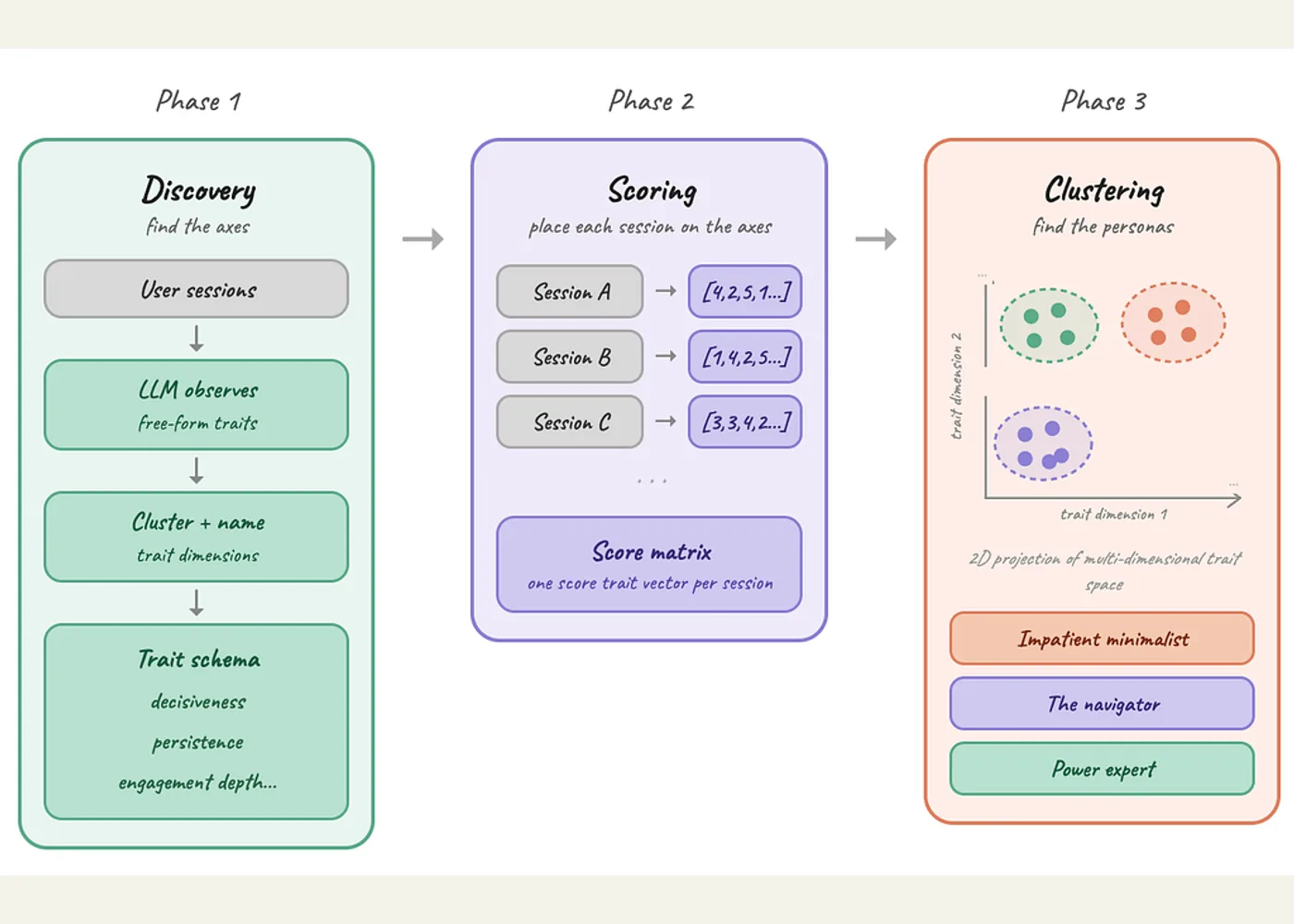
The proposed pipeline has three stages. First, it condenses PostHog sessions into behavioral timelines, asks a model for open ended observations, then groups those observations into trait dimensions. Next, it scores another set of sessions against those dimensions. Finally, it clusters the score vectors into personas with instructions for the browser agent and questions for the judge. The article also describes comparing Murphy's test traces with the real session clusters to see where the simulated behavior drifts. Its pipeline diagram gives a quick map of the architecture.

To explore the implementation, start with the repository README. It documents local setup with Python, uv, Chromium, and an LLM provider key. A basic run targets a site with uv run murphy --url https://example.com; the generated plan pauses for review before execution. Persona discovery is an optional --discover-personas mode and requires PostHog credentials and compatible event data. Use the article to understand the research design, then inspect the repository before applying it to your own product.
These personas are behavioral approximations, not representatives who can explain their intent. The author reports that fidelity weakened on more complex goals, so check the action trace and judge rationale before treating a pass or failure as a user finding. The article says sensitive fields are removed before model analysis; teams should still verify their own event collection, filtering, and access controls.
Example use cases
- Suggested application — onboarding review: Discover patterns such as hesitation or repeated backtracking, then test whether an agent following that pattern can finish sign up.
- Suggested application — abandonment testing: Ask a persona to leave a checkout or creation flow midway and inspect saved state and recovery cues.
- Suggested application — evaluation audit: Compare an agent's actions with the session cluster it was assigned, and flag tests whose behavior diverges before using their verdicts.
Sources
- Murphy Knows Your Users Better Than You Do — Prosus AI Tech Blog
- Murphy repository and README — ProsusAI
Source image: Kevin Ngo / Prosus AI Tech Blog.
Maintained by Jetskibay. Reviewed 2026-09-29T00:00:00Z.