Ask for the shirt, get the vest
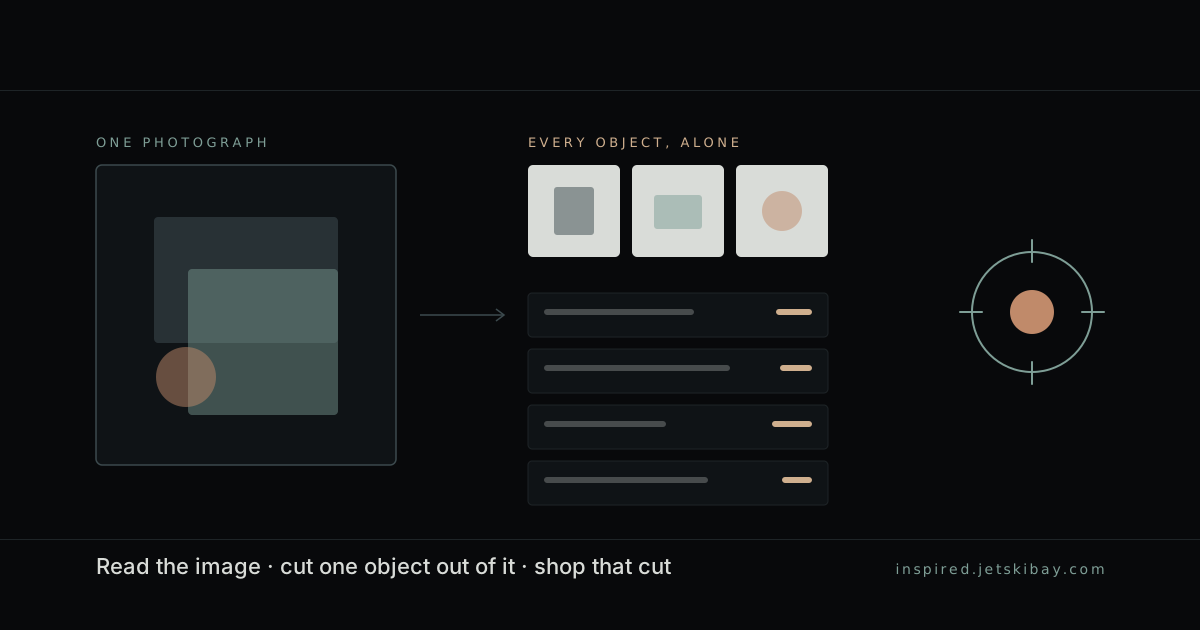
An article about a failure that only exists because image models got good: ask one to extract the shirt from a photo of someone in a vest over a shirt, and it returns a shirt, on white, centred, still wearing the vest.
It did what was asked. The shirt region of that photograph contains a vest, and nothing in the instruction said the vest was the problem.
This is the account of what "extract the shirt on a white background" turned into in the Inspired pipeline — thirteen ordered clauses — and why each one is there. Every rule in it was earned by a specific reproducible wrong answer.
What it argues
- An isolation instruction is a deletion instruction. Leading with the occluder named as something to remove beat every description-first phrasing that was tried.
- Uncertainty has to be encoded as a ceiling, not an assertion. "Show no hardware beyond what the photo shows (…)" degrades into a plainer garment when the upstream description is wrong. "Add a button placket with six buttons" degrades into a fabricated one. Same information, opposite failure modes.
- Absence must be named. No lapel, no hood, no second fabric through the gap. Anything you do not forbid is something the model may helpfully supply.
Along the way: why the reading pass returns occlusion relationships rather than
just names, how a forgotten covered_by is recovered from a sibling's covers,
why "keep the silhouette as photographed" carries no actionable information, and
the two upgrades image models apply that nobody asked for — a crisper finish and
a more flattering cut.
Who it helps
Anyone extracting one object from a photograph of several, whether or not the objects are clothes. The closing section separates what transferred when the pipeline stopped being fashion-only — almost every structural rule — from what was only vocabulary.
Limits
It is a field report from one pipeline: OpenAI for reading, Pruna
p-image-edit for extraction, as deployed in September 2026. No A/B numbers, no
benchmark, no ablation table — the evidence is the shape of the prompts that
survived and the failures each clause was written against. Another model may
need a different instruction; the failure modes are likely to be the same ones.
About 3,000 words, twelve minutes. Available as Markdown and as a standalone HTML page.
Make it yours.
Choose the format that fits your workflow.
Markdown
text/markdown · v1.0.0 · en · 13 KB
File details & reuse
License: All rights reserved
Redistribution: prohibited
SHA-256 6729523b9f2e9a7afbca673c678d165f427d8b3eb3188da97ca58d183bf778b8
Standalone HTML
text/html · v1.0.0 · en · 18 KB
File details & reuse
License: All rights reserved
Redistribution: prohibited
SHA-256 573924c55b68226522f93ca7f980e5836a63deba1d3e9d21934a5f0adf634a2c
Ships with.
Make it your own.
EXAMPLES & PROMPTSI'm building a product-image pipeline. Given a photo of a desk with a laptop, a
pair of headphones and a keyboard on it, I need one clean e-commerce product
shot per object, on white, and my current prompt is:
"Extract the headphones from the image on a white background."
The results are subtly wrong in ways I can't pin down — sometimes the keyboard
is still in the shot, sometimes the headphones come back glossier than the
photo, and the earcups are a slightly different shape.
Read "Ask for the shirt, get the vest" and rewrite my pipeline against it.
Specifically:
1. Tell me what my reading pass has to return before the extraction step can
work at all. I currently only get a name and a one-line description per
object, and the article says that is not enough.
2. Rebuild the extraction instruction in the order the article ends with, using
the desk photo as the worked example. Translate the fashion vocabulary the
way its last section does — placement instead of layer, details instead of
hardware, form instead of silhouette.
3. My descriptions sometimes say things like "USB-C port, possibly a second
one". Show me what the ceiling formulation looks like for that, and explain
what happens differently when the description turns out to be wrong.
4. List what I should explicitly forbid for this photo, including the absences.
One constraint: do not add a verification step that compares the cutout back to
the source photo. The article is explicit that this pipeline does not do that,
and I want to fix the instruction, not bolt on a checker.
Published by Inspired. Fictional brand, working prototype.