
Supertonic
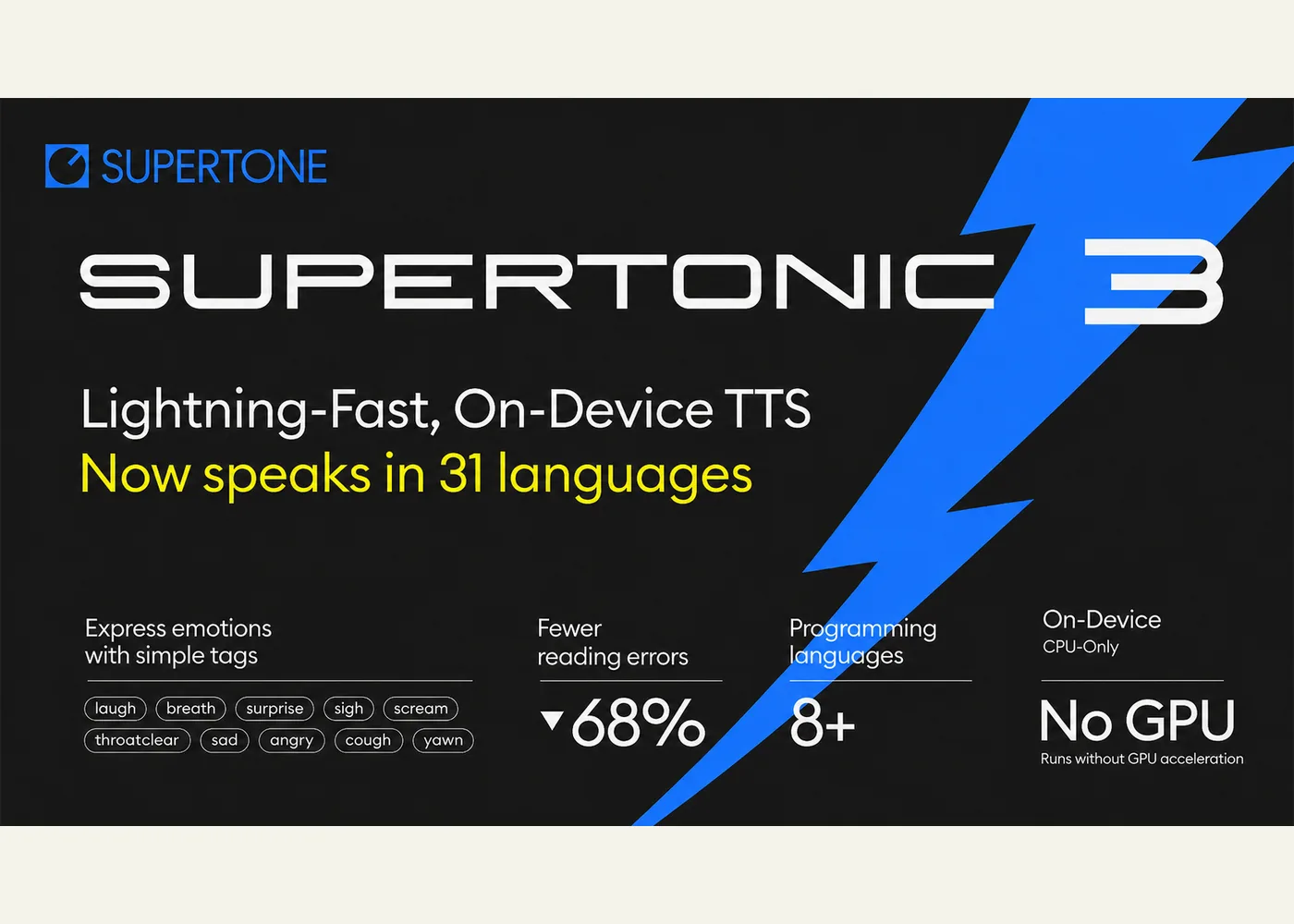
Supertonic is a text-to-speech project for developers who want to generate audio on a device they control. Its archived repository supplies ONNX inference examples for Python, Node.js, browsers, and several mobile and systems languages. The Supertonic 3 model card describes a 31-language release with fixed preset voices and optional expression tags such as <laugh> and <sigh>. This makes it a useful starting point for testing speech in an application without routing every synthesis request to a hosted API.
The repository was archived in September 2026. It is read-only, development and support have ended, and the original hosted demo and Voice Builder are not part of the archive. Treat the code and model as a preserved implementation that you can evaluate and maintain yourself. The sample code uses the MIT license; the model weights have a separate OpenRAIL-M license, so check that license before redistribution or deployment. The open-weight package provides preset voices rather than an official voice-cloning pipeline.
To start, follow the repository's archive quick start. It uses Python 3.11, downloads the pinned Supertonic 3 model snapshot from the archived Hugging Face namespace into assets/, installs the Python example's requirements, then runs example_onnx.py to write a WAV file. Once the dependencies and model files are present, that example performs synthesis locally. The other runtime examples reuse the downloaded assets; browser and mobile integrations still need testing against your target device's memory, startup time, and audio behavior.
For an evaluation, begin with your actual text: abbreviations, names, numbers, and each language you intend to support. Listen for skipped or repeated words and awkward pronunciations, then compare latency and resource use on the hardware that will ship. The model card includes author-reported accuracy and footprint comparisons, but your own audio and device measurements are the relevant acceptance test.
Example use cases
- Suggested application — offline reader: Add local narration to an e-reader or accessibility prototype, then test long passages and interruptions on the device.
- Suggested application — multilingual kiosk: Generate short spoken prompts in the languages your visitors use and review pronunciation with native speakers.
- Suggested application — game dialogue prototype: Render lines with preset voices and expression tags while measuring synthesis time on the intended hardware.
Sources
- Supertonic archived repository and quick start
- Supertonic 3 model card and model license
- Supertonic code license
Source image: Supertone Inc..
Maintained by Jetskibay. Reviewed 2026-09-29T00:00:00Z.