
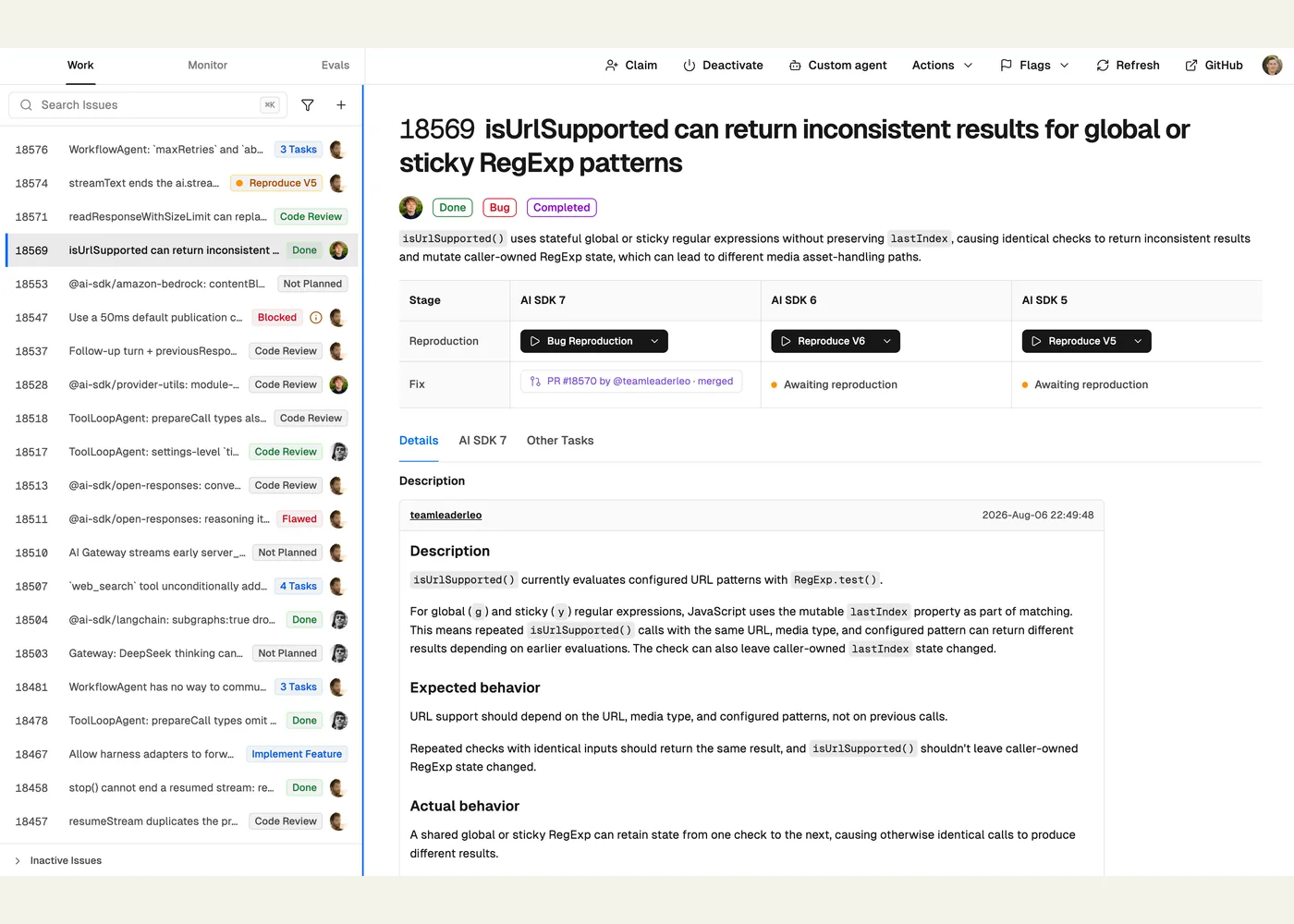
Building a software factory for AI SDK
Vercel’s engineering article describes how its AI SDK team automated issue classification, analysis, implementation, review, and backports while keeping merge decisions with people. It is a case study for maintainers exploring agent-assisted repository work. Read the article.
The system asks specialized agents to supply evidence: reproduce a bug, investigate a feature request, propose a patch, or assess risk. A worked example follows a blocked-domain request from issue #17898 to merged PR #18033. Vercel also describes isolated execution, restricted secrets and network access, and human review for runs triggered by public issues.
The team began with a local CLI before adding webhooks, hosted workers, queues, sandboxes, storage, and a review interface. Its throughput results describe roughly four weeks of its own production use; they do not predict another repository’s results. The article is not a complete installation manual. Architecture and implementation account.
How to explore the idea
A suggested first experiment is an issue classifier on a small historical sample. Define the expected labels before running it and have a maintainer review mistakes. Add a second stage only when the first one saves useful review time. Keep evidence next to each proposed decision so a reviewer can judge it without rerunning the investigation.
Example use cases
- Suggested application — issue triage: Classify incoming bug, feature, and documentation reports, attach the reasoning, and let maintainers correct labels before any code-writing agent runs.
- Suggested application — reproducible bug fixes: Require a failing test or minimal reproduction before an agent proposes a patch; give reviewers both artifacts beside the diff.
- Suggested application — release backports: After a human merges a fix, ask a dedicated agent to try supported release branches and flag conflicts for focused review.
Sources
Source image: Vercel.
Maintained by Jetskibay. Reviewed 2026-09-29T00:00:00Z.