
AVTR-1: Live dialogue avatars from a portrait
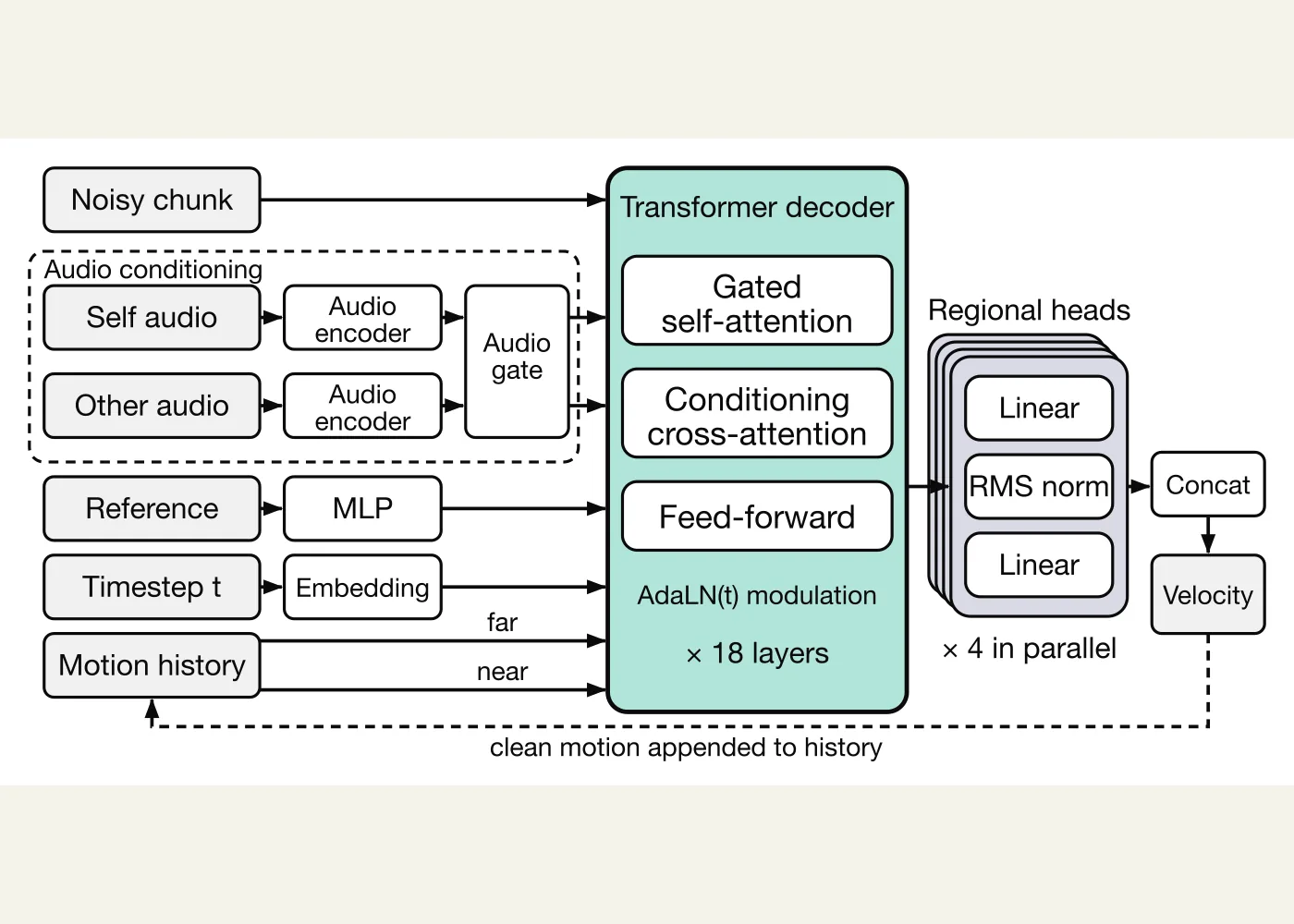
AVTR-1 is for developers and media researchers who want a portrait avatar to speak and visibly listen during a conversation. The released repository combines model weights, inference code and an interactive streaming demo. It takes a reference portrait plus separate speech and listening audio streams; Avaturn says it generates lip-synced and listening motion at 25 frames per second on suitable single-GPU hardware. The repository README includes measured per-chunk timings across several GPUs, but those figures are publisher benchmarks rather than a guarantee for another setup.
To try it locally, start with the GitHub quick start. It calls for Linux, an NVIDIA GPU, CUDA 12.x, TensorRT 10.x and pixi. Clone the repository, run pixi install, then pixi run download to fetch the weights; the download flow prompts for Hugging Face authentication. Build the local TensorRT engines with pixi run build-trt-engines before launching pixi run interactive-demo. The README also gives offline commands for one speaker, a two-person exchange and idle motion, making it possible to inspect output without integrating a live session. The model card describes the weights and reference assets separately from the GitHub inference code.
Plan around the project's current boundaries. The README marks its technical report and production-ready backend as coming soon. Its renderer and streamer have separate noncommercial licenses, while the model and scripts use the AVTR-1 Community License; the pipeline also includes InsightFace models restricted to noncommercial research use. Read the component license map and third-party notices before commercial deployment. The model card says near-frontal portraits work best and warns of uneven results for underrepresented speakers, difficult lighting, long speech and noisy audio. It also requires informed consent for identifiable likenesses.
Example use cases
- Suggested application: conversational prototype. Animate a fictional character or a person who has consented in a two-way voice interface and compare speaking and listening turns.
- Suggested application: dialogue preview. Render both sides of a scripted conversation with the offline two-speaker workflow, then edit the clips into a scene.
- Suggested application: performance study. Test latency and visual quality on your own NVIDIA GPU, portrait styles and audio conditions before committing to a live experience.
Sources
- AVTR-1 GitHub repository and README
- AVTR-1 model card
- AVTR-1 project page
- Component license map
- Third-party notices
Source image: Avaturn, AVTR-1 project page.
Maintained by Jetskibay. Reviewed 2026-09-29T00:00:00Z.